Nowadays, in a competitive digital world, only creating content to boost your brand image is not enough. Businesses and startups need to have a proper knowledge of content optimisation to ensure content stands out to both search engines and potential customers.
A report of 2025 indicated that 76% of businesses that invest in SEO have seen a sustained increase in traffic over time. It is the bridge between volume content and tangible results. Read this blog to learn more about content optimisation.
Target the Right Keywords with Search Intent

Start with a comprehensive keyword research using tools like Wordstream, Ahrefs, Semrush, or Google Keyword Planner. Identify the keywords that not only have good search volume but also match the actual intent of your audience.
Identify whether the keyword is informational, transactional, or navigational, depending on the content. Targeting the right keywords ensures your content meets what users are looking for, boosting relevance and rankings.
Craft SEO-Friendly Titles and Meta Descriptions
Your title tag and meta descriptions are often the first impressions users get on search engine result pages. Try to make them compelling and keyword-rich without any stuffing of unnecessary keywords.
Use verb actions, such as discover, learn, or explore, to encourage clicks. Both should clearly convey what the content covers and its benefits to the reader, increasing your click-through rate (CTR). Several content outsourcing agencies, such as Das Writing Services Pvt. Ltd can provide you with content with clear and catchy titles and meta descriptions.
Frame Content for Readability and Engagement
Break your content into clear sections with descriptive subheadings (H2, H3) in various types of content writing. Use short paragraphs, bullet points, and numbered lists to make scanning easy.
Highlight key terms in bold to capture attention. This structure improves user experience and helps search engines understand your content’s hierarchy and relevance.
Optimise On-Page Elements and Internal Linking
In addition to keywords, optimise images with alternate texts and compress them for faster loading. Always ensure URLs are lucid and descriptive for the viewers who are surfing your website.
Use internal linking wisely to connect related content, which improves site navigation and distributes page authority across your site. Both users and search engines benefit from a logical linking structure.
Improve Technical Factors like Page Speed and Mobile-Friendliness
Core web vital aspects, such as metrics measuring loading performance, interactivity, and visual stability, are crucial ranking factors. Optimise images, leverage browser caching, and choose reliable hosting to enhance page speed.
Ensure the design of your website is responsive, so that it will provide seamless experiences across devices, especially mobile phones, where most search happens. A seamless experience is one of the key aspects of getting higher ranks in Google’s SERP.
Use Schema Markup for Feature Snippets
Try to add structured data to your content using schema markup to help search engines understand context properly. This can increase your chances of appearing in feature snippets, FAQs, and other enhanced search features, drawing more traffic.
Results showing in the feature snippet can draw more organic traffic, eventually generating higher click-through rates. This feature is extremely essential to draw more leads in today’s digital age.
Ways to Optimise Content for Conversions
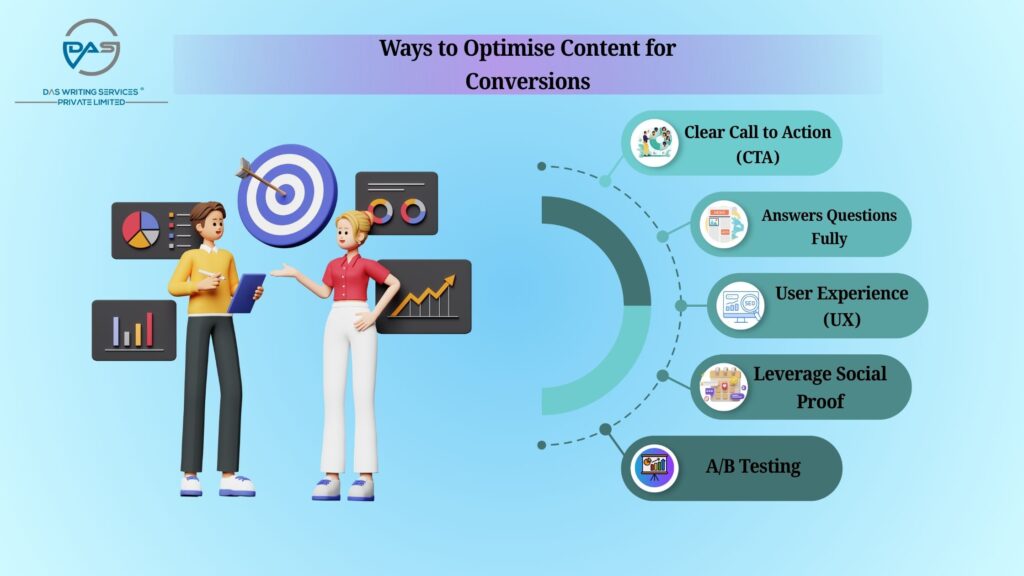
These are some methods through which you can optimise your content to convert visitors into customers or subscribers:
- Clear Call to Action (CTA): Place prominent and compelling CTAs that will guide users on the next steps, such as signing up, downloading, or contacting you.
- Answers Questions Fully: Address common customer pain points and objections within your content to build trust and reduce hesitation.
- User Experience (UX): Make navigation intuitive and the reading experience smooth. A clutter-free and fast-engaging page reduces bounce rates and encourages deeper engagement.
- Leverage Social Proof: Include testimonials, reviews, or case studies to reinforce credibility and influence buyers’ decisions.
- A/B Testing: Experiment with different headline variants, CTA placements, and content formats to discover what converts best.
Regularly Update Your Content
Regularly update your various content writing examples, such as articles, web pages, or blogs. Try to add statistics, new insights, and refresh multimedia elements like images and videos. Search engines favour fresh and updated content. Thus, keeping content current and updated ensures sustained rankings and continued visitor interest.
Final Words
Mastering content optimisation is invaluable for startups and businesses that want to grow organically. It requires a blend of keyword targeting, technical SEO, user-centred design, and conversion-focused tactics. When you carefully optimise your content, it will not only achieve higher ranks in SERP but also convert audiences into potential customers.