Search behavior no longer follows a straight line. People move fluidly between Google, social platforms, marketplaces, AI tools, and community forums before making a decision. That shift has changed how visibility works online. Search everywhere optimization addresses this reality by helping brands stay discoverable across every touchpoint a user interacts with.
This guide breaks down why it matters and how businesses can build a sustainable strategy for complex, multi-search journeys.
What is Search Everywhere Optimization?
Search Everywhere Optimization expands the traditional search strategy beyond just search engines. It aims for presence and relevance across every platform where people discover and evaluate information. It includes AI tools, social platforms, videos, marketplaces, forums, and community networks.
While Google still processes an average of 16.4 billion searches daily in 2025, people now split attention across AI engines, social networks, video platforms, and commerce search tools.
Traditional SEO worked when a single index dominated. Today’s journey is multi-touch and multi-platform. Search everywhere optimization makes sure your content shows up at every stage of that journey.
Companies like Das Writing Services are helping brands rethink their digital content beyond classic SEO habits. They build strategies that account for where users really look before making a decision.
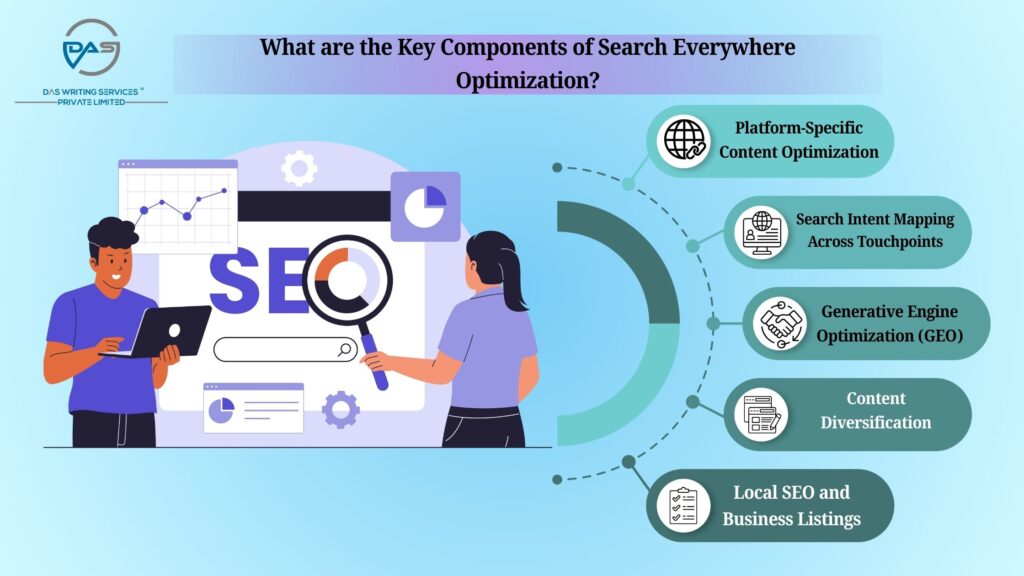
What are the Key Components of Search Everywhere Optimization?
Multi-search works best when its core components operate together. Each element strengthens visibility at different stages of the user journey.
Before breaking them down, it is important to understand that no single platform drives outcomes alone. Consistency across channels is what builds momentum.
1. Platform-Specific Content Optimization
Each platform has its own discovery logic. Search engines favor structured relevance, social platforms prioritize engagement, and marketplaces reward conversion data. Content must be adapted without losing its core message. This is where disciplined content optimization plays a critical role.
2. Search Intent Mapping Across Touchpoints
Different platforms reflect different search intents. Informational intent may surface on search engines, while validation intent shows up on forums or YouTube. Mapping intent ensures the right content appears at the right stage.
3. Generative Engine Optimization (GEO)
As AI-generated answers become more prominent through tools such as ChatGPT and Google AI Overviews, Generative Engine Optimization has become an important extension of multi-search. Instead of focusing only on rankings, GEO ensures content is structured in a way that AI systems can easily interpret and surface as direct responses.
4. Content Diversification
Different channels demand different formats and consumption styles. Long-form blogs support traditional search visibility, while short-form videos and visual content capture attention on social media. Tailoring content to each platform improves engagement, keeps users interested, and reduces drop-offs across the search journey.
5. Local SEO and Business Listings
Local search continues to be a high-intent traffic driver, especially for service-based businesses. Optimizing Google Business Profiles and local directory listings helps brands appear when users are actively searching for nearby solutions.
Together, these components create continuity. Without them, even high-quality content risks becoming invisible during key moments of influence.
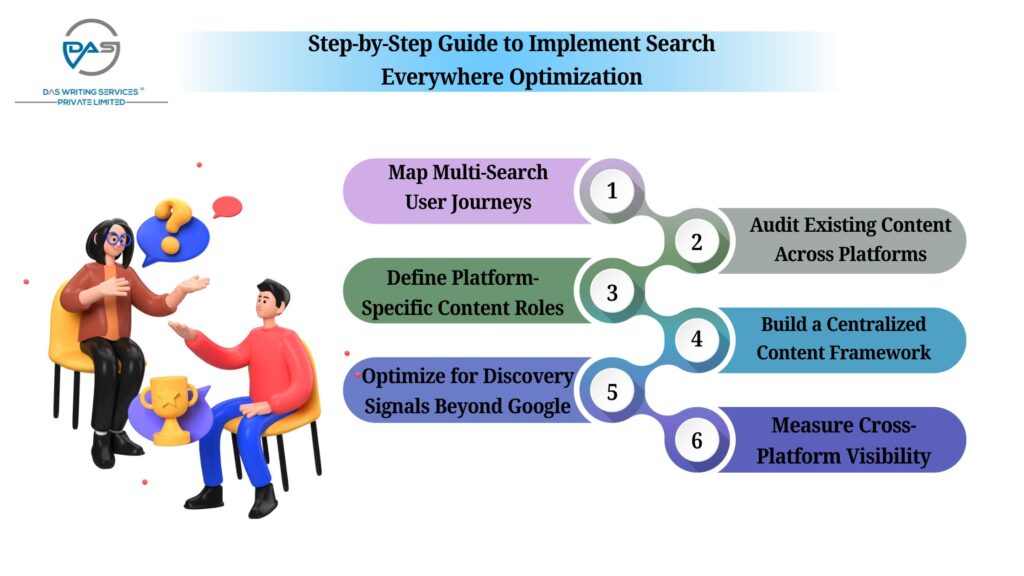
Step-by-Step Guide to Implement Search Everywhere Optimization
Implementing search everywhere optimization requires structure, not guesswork. The steps below outline a practical approach that scales. To begin, brands must shift their mindset from ranking pages to supporting journeys.
1. Map Multi-Search User Journeys
Start by identifying where your audience searches at different stages. This includes search engines, social platforms, video sites, AI tools, and marketplaces. Understanding this flow prevents over-investing in a single channel.
2. Audit Existing Content Across Platforms
Next, review how your brand appears today. Look for inconsistencies in messaging, outdated content, or missing presence. Many businesses discover they lack alignment between blogs, social posts, and third-party mentions.
3. Define Platform-Specific Content Roles
Each channel should serve a clear purpose. Blogs can address depth and authority, videos can explain visually, and social content can reinforce relevance. This clarity supports better resource allocation and ties back to Ideal blog post length decisions for long-form content.
4. Build a Centralized Content Framework
At this stage, develop a unified content plan that connects all channels. Topics should originate from shared research and then be adapted. This is something top content writing companies in India excel at. They adapt core messaging to diverse discovery platforms.
5. Optimize for Discovery Signals Beyond Google
Discovery depends on more than keywords. Engagement, watch time, saves, reviews, and citations influence visibility across platforms. Optimizing for these signals strengthens performance where traditional SEO stops.
6. Measure Cross-Platform Visibility
Finally, track mentions, impressions, conversions, and brand recall across channels. Multi-search success shows up in compounded influence, not single-platform metrics.
This structured approach helps businesses maintain relevance even as platforms evolve.
Final Word
Search everywhere optimization reflects how people actually search today. Brands that embrace it gain resilience across shifting platforms and algorithms. By aligning content, intent, and authority across channels, businesses reduce dependency on any single traffic source.
Teams supported by experienced partners like Das Writing Services Pvt. Ltd. often find it easier to operationalize this strategy without losing focus. In a multi-search world, visibility belongs to those who show up everywhere.