Search rankings no longer depend solely on backlinks. In 2025, Google’s Search Quality Evaluator Guidelines reinforced a clear shift: brands people recognise, trust, and search for consistently outperform sites built only on SEO metrics.
A SparkToro study also found that branded search queries influence over 44% of Google traffic across competitive keywords. This makes the debate sharper than ever. When resources are limited, what truly matters more today: brand authority or domain authority?
Understanding Brand Authority
Brand authority refers to a brand’s credibility, recognizability, and trustworthiness within its industry. It is shaped by audience perception rather than technical metrics.

Search engines increasingly rely on brand-related signals to evaluate authority, especially in competitive niches. These signals typically include the following:
- Trustworthiness: Consistent delivery on promises builds confidence in a brand’s digital content and offerings.
- Brand Recognition: Familiar brands are more likely to earn clicks, repeat visits, and branded searches.
- Audience Engagement: Loyal users who interact, share, and return signal long-term credibility.
Moz has also introduced a Brand Authority score, measured on a 1 to 100 scale, to assess brand strength based on online presence and reputation. It reflects a broader shift toward trust-based evaluation.
What is Domain Authority?
Domain Authority (DA) is an SEO metric developed by Moz to predict how likely a website is to rank on search engine results pages. It is measured on a scale of 1 to 100, where higher scores indicate stronger ranking potential.
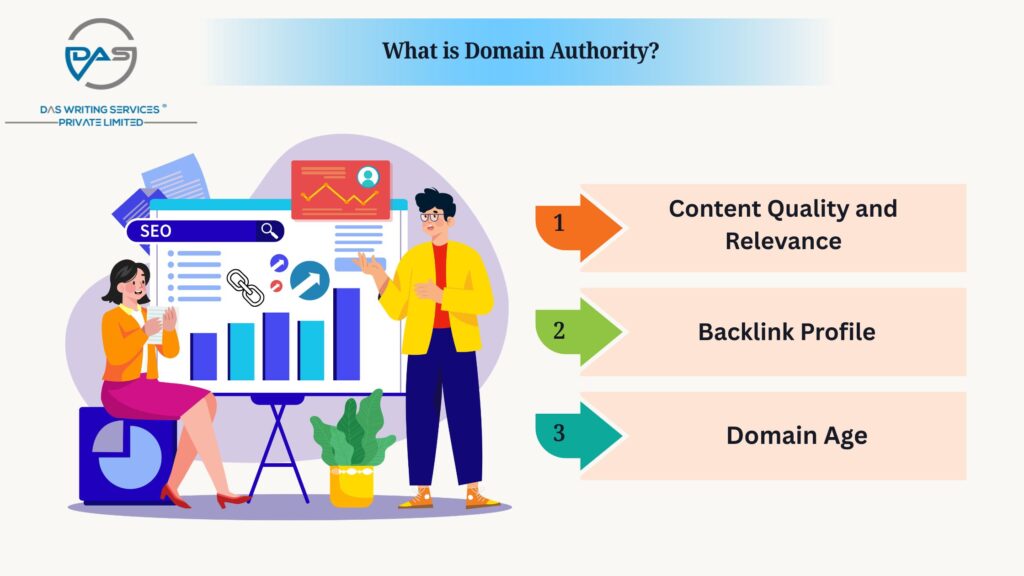
DA does not represent a Google ranking factor, but it remains a widely used benchmark among SEO professionals. The score is influenced by a few core elements, which is why SEO Article Writing Services often focus on improving authority through quality content and strong link-building strategies:
- Content Quality and Relevance: Well-structured, useful content supports stronger authority by attracting organic links and engagement.
- Backlink Profile: High-quality backlinks from authoritative and relevant websites strengthen domain authority and signal credibility.
- Domain Age: Older domains often carry more trust because they have had more time to establish consistent signals.
Without a solid content plan, even a high domain authority site can struggle to convert traffic into meaningful business outcomes.
This is why brands working with content marketing agencies like Das Writing Services prioritise authority-led content that builds recognition and credibility, not just rankings.
What are the Key Differences Between Brand Authority and Domain Authority?
| Aspect | Brand Authority | Domain Authority |
| Primary focus | Trust, recognition, and audience perception. | Backlinks, linking domains, and technical SEO factors. |
| Who evaluates it | Inferred by search engines and shaped by user behavior. | Calculated by third-party tools such as Moz. |
| Core signals | Branded searches, mentions, engagement, thought leadership. | Backlink quality, domain age, and site structure. |
| Control level | It was built through consistent messaging, expertise, and value | It is largely influenced by external links and SEO efforts |
| Impact on conversions | Directly improves trust, click-through rates, and loyalty. | Primarily affects visibility, not user trust. |
| Role in long-term growth | Drives sustainable authority and brand preference. | Supports short- to mid-term ranking potential. |
After comparing both, it becomes clear that domain authority helps you get discovered, while brand authority determines whether users trust, engage, and convert.
Brand Authority vs Domain Authority – Why Do You Still Need Both?
Domain authority helps search engines discover and index content efficiently. It sets the foundation on which brand signals can perform.
At the same time, brand authority amplifies the effectiveness of every SEO effort. Content from trusted brands earns links naturally, ranks faster, and converts better.
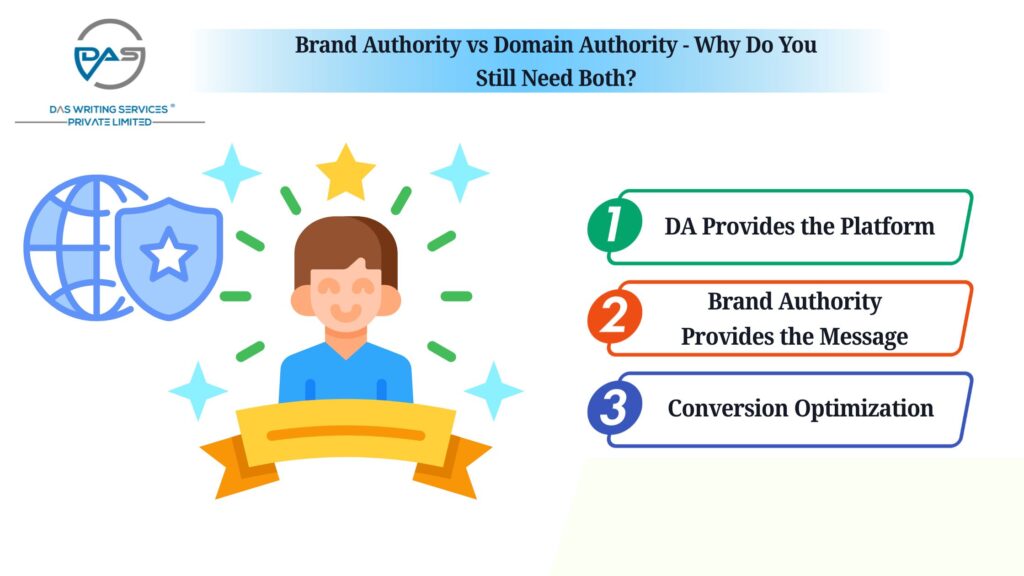
The synergy between the two is where the magic happens for modern businesses. Consider how they work together:
- DA Provides the Platform: It allows your voice to reach a wider audience.
- Brand Authority Provides the Message: It ensures that once you have the audience’s attention, you provide enough value to keep it.
- Conversion Optimization: Users are more likely to convert on a site that exhibits both technical stability and clear brand expertise.
This is where collaboration with a professional writer becomes critical. Many organizations partner with Das Writing Services to bridge the gap between technical SEO requirements and high-quality storytelling that resonates with real people.
How to Build Brand Authority in an AI-First World?
AI has made content easier to produce, but harder to trust. Brand authority now depends on signals that automation cannot replicate. To build authority in this environment, brands should focus on these factors:
- Original thinking, real examples, and expert opinions stand out from generic AI content.
- Branded searches, direct traffic, and repeat visits signal credibility to search engines.
- A clear voice and positioning reinforce recognition and trust.
- Many brands choose to outsource content writing while maintaining editorial control to protect authority.
Das Writing Services often helps brands here. They align editorial standards with scalable execution while protecting brand integrity.
Once these foundations are in place, SEO performance becomes a byproduct of authority, not the goal itself.
Conclusion
In 2026, domain authority helps you enter the conversation, but brand authority decides whether people listen. Search engines increasingly reward brands that demonstrate trust, relevance, and real expertise.
Domain authority still matters, but it is no longer enough on its own. Brands that invest in authority-led content strategies see stronger rankings, better conversions, and long-term resilience.
The smartest path forward combines technical SEO with brand-first thinking. When your content reflects genuine expertise and clear positioning, both users and algorithms respond.