Imagine searching “how to keep skin hydrated in winter” and getting a clear answer instantly, without clicking any blue link that pops up on the page. That is how AI search works.
Traditional SEO still matters to make your content perform, but visibility today means being understood, cited, and trusted by AI.
Understanding the differences between the two is essential for brands aiming to stay discoverable. This blog first explains the differences in the table, and then the ways content creators should blend AI search and SEO work to maintain relevance, trust, and consistent online visibility.
What are the Key Differences: AI Search vs. Traditional SEO
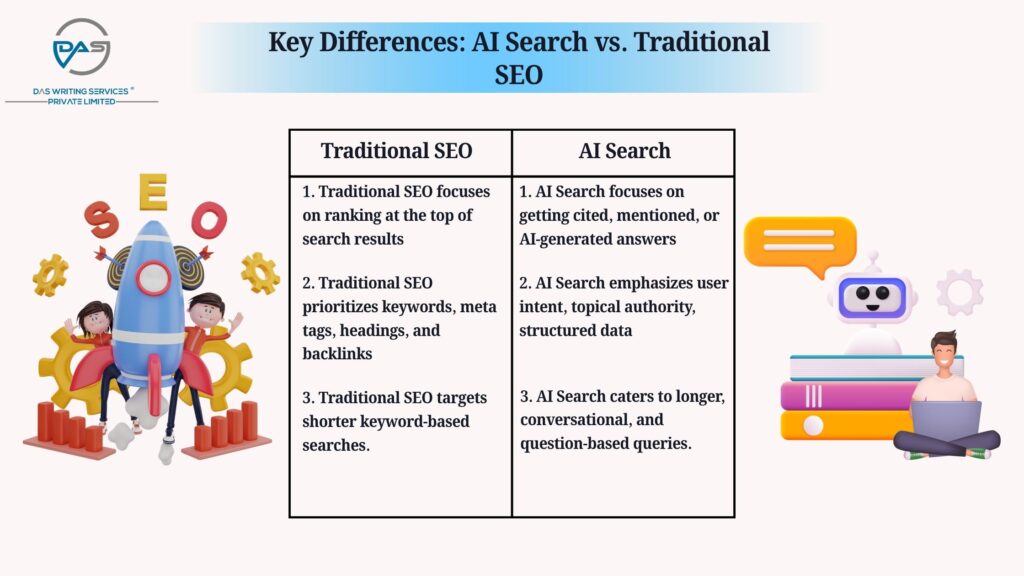
The table highlights the key differences between AI search and traditional SEO:
| Aspects | Traditional SEO | AI Search |
| Goal | Rank at the top of the SERP (Search Engine Results Pages) or on the first page | Be cited, mentioned, or recommended in the AI Overview section and prominent AI platforms |
| Optimization Focus | More preference on keyword placements, on-page optimization (meta tags, headings), and generating backlinks | More focus on user search intent, topical authority, structured data, and clear, concise formatting so AI can easily extract |
| Query Style | Shorter, keyword-focused queries (e.g., “best biryani Kolkata”). | Longer, conversational, and question-based (e.g., “how to increase credit score”). |
| User Behavior | Users get a list of blue links | Users get instant, concise, and direct answers |
| Primary Metrics | Organic traffic, click-through rates (CTR), and conversions. | Citation frequency, brand mentions, and engagement within AI interfaces |
What do Content Creators Must Adapt Between AI Search and Traditional SEO?
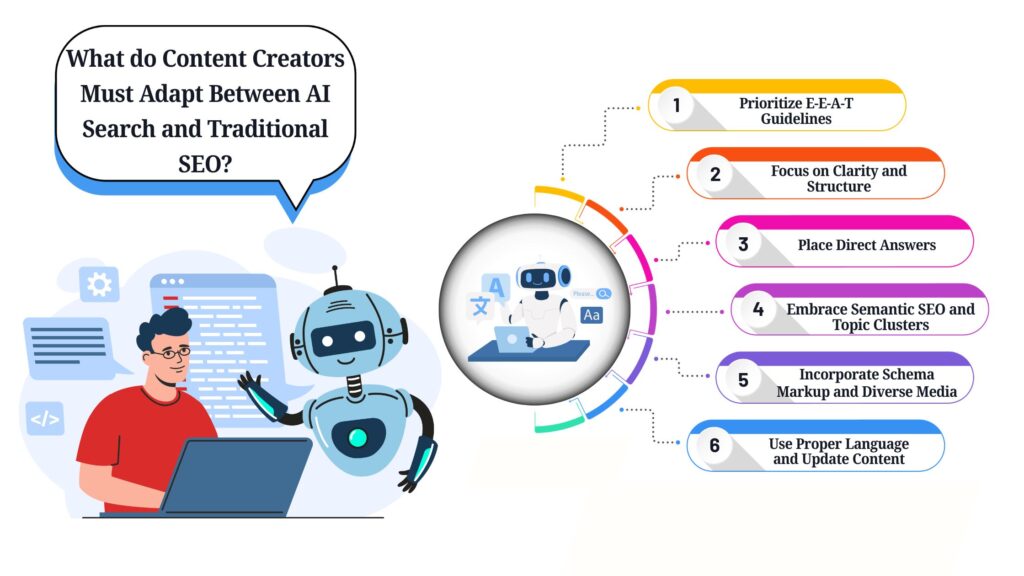
According to the digital marketing consultants in India, content creators need to blend these two strategies to see exponential business growth. Nowadays, combining traditional SEO fundamentals with generative engine optimization (GEO) and answer engine optimization is needed to ensure success.
Below are proven strategies to optimize your content for SEO, AEO, and GEO effectively:
- Prioritize E-E-A-T Guidelines
After Google published the updated search rater guidelines, they focused more on content that demonstrates E-E-A-T (Experience, Expertise, Authoritativeness, Trustworthiness).
It means your content must have information cited by reputable sources, provide original research, and real-world experience to build authority. Top website content writing agencies, such as Das Writing Services, have a team of professional writers who can help you produce such content at affordable rates.
- Focus on Clarity and Structure
You need to create scannable content so that both humans and search engine crawlers can easily read and understand. Create an attractive H2, then use descriptive headings (H2, H3, …) for different segments of a blog post that generally contain 1,333 words (average).
Break content into short, digestible paragraphs of 3 to 4 lines and use bullet points or numbered lists to make it reader-friendly.
- Place Direct Answers
When you enter a query, such as “how to reduce high blood pressure?”, the answer starts with “To reduce high blood pressure, focus on a….” This is the new approach to respond to internet users.
You need to start with direct answers to potential questions near the beginning of the relevant section so that users don’t have to put much effort into finding information.
- Embrace Semantic SEO and Topic Clusters
Traditional SEO is all about placing keywords. Move beyond that! Create content hubs that comprehensively cover broad topics and interlink related articles meaningfully to demonstrate depth and expertise to AI platforms. This approach is especially valuable for businesses offering content writing services in UAE, as it helps establish topical authority, improve content discoverability, and increase visibility across both traditional search engines and AI-powered search experiences.
Expert and updated content writing agencies, such as Das Writing Services, have profound knowledge regarding branded keywords and long-tail AI search keywords to strengthen your business’s online presence.
- Incorporate Schema Markup and Diverse Media
Use schema types (such as FAQPage, HowTo, Review, Product) to label topics on your page; this approach enables AI understand the context and purpose of your content.
Moreover, attach relevant images, infographics, and upload videos to ensure they are optimized with descriptive alt text and schema markup. It not only helps users and crawlers understand the content but also increases visibility in multimodal search results.
- Use Proper Language and Update Content
The trend is to ask natural language questions to voice assistants and AI platforms. So, frame headings as questions, whether it is H1, H2, or H3, and provide clear, conversational answers.
Apart from that, it is essential to update and republish existing content regularly to maintain a strong content experience for users. Outdated or obsolete information can mislead readers in several harmful ways and negatively impact engagement. Google tends to favor up-to-date, accurate, and relevant information, making freshness an important ranking factor that contributes to both search visibility and an improved content experience.
The Final Takeaway
The introduction of AI does not replace traditional SEO; it refines it. So, there is no debate between AI search and traditional SEO. To stay visible, content creators must balance strong SEO fundamentals with AI-focused strategies such as providing direct answers, demonstrating authority, structuring content, using schema markup, etc. Either train your in-house team or partner with one of the content marketing agencies in India, such as Das Writing Services Private Limited, to gain sustainable visibility across both search engines and AI-driven platforms.