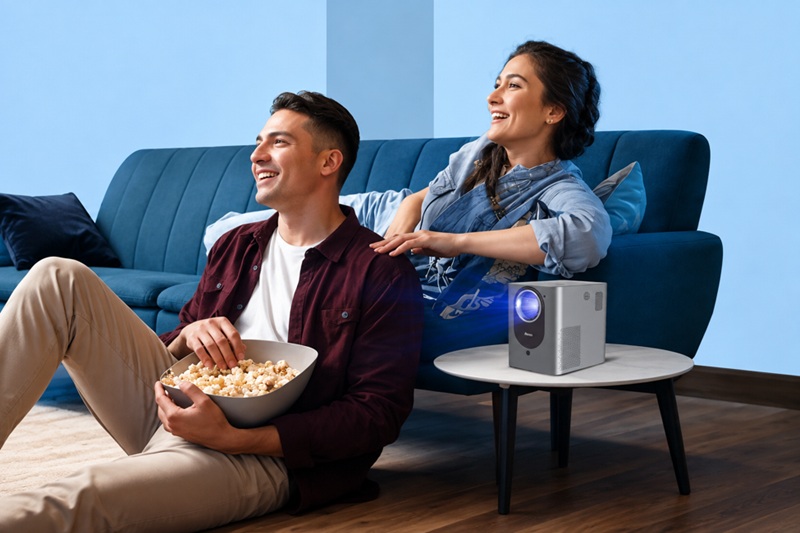
Choose a projector if you want a big, cinematic screen for movies and sports and can dim the room. Choose a smart TV if you watch in bright rooms, want zero setup and use it for everyday viewing. For a pure home theatre feel, a home theatre projector gives you far more screen for the space.
Both can anchor a good home theatre, but they suit different rooms and habits. Here is how they compare on the things that matter.
Projector vs Smart TV at a Glance
| Factor | Projector | Smart TV |
| Screen size | Very large, adjustable (often 100 inches and beyond) | Fixed size, larger sizes cost much more |
| Daytime viewing | Needs a dim or dark room | Works well in bright rooms |
| Setup | Needs placement, distance and a surface | Place it and switch it on |
| Picture feel | Cinematic, big-screen look | Sharper, punchier in bright light |
| Portability | Easy to move or store | Bulky and fixed |
| Sound | Usually needs external speakers | Built-in speakers, better with a soundbar |
Screen Size: The Biggest Advantage of a Projector
A projector’s main strength is size. A projector can create a very large image from a small box, while the cost of a TV rises quickly as screens get bigger. If your aim is a theatre-style experience, a projector delivers the scale a TV struggles to match at a similar budget.
Brightness and Room Lighting
This is where TVs win. A TV makes its own light, so it looks good with the curtains open. A projector’s image is easily washed out by daylight and lamps.
Brightness is measured in lumens. As a general rule of thumb, a dark room can work well with a moderate brightness rating, while a bright room needs a much higher one. If you will watch mostly in the evening or in a room you can darken, a projector is fine. If your room gets strong daylight and you cannot control it, a smart TV is the safer choice.
Picture Quality: Resolution and Contrast
Check resolution first. Full HD is a sensible starting point for a projector at home, and higher resolutions improve detail on larger screens. Contrast also matters. In a dark room, a projector gives a rich, immersive picture. In a lit room, a TV generally shows deeper blacks and stronger colour.
Setup: Wall Projector, Throw Distance and Screen
A TV needs a stand or a wall mount. A projector needs a little planning:
- Surface. A plain, light-coloured wall can work as a wall projector surface, and a dedicated screen gives a more even, brighter image.
- Throw distance. The distance between the projector and the screen decides the image size. Check the throw ratio and keep enough space for the size you want.
- Placement. Ceiling mount, shelf or table all work, but the position should be stable and level with the screen.
- Sound. Most projectors have modest built-in sound, so plan on external speakers or a soundbar for a proper home theatre feel.
A vision projector pointed at a clear wall is the easiest way to start, since you do not need to buy a separate screen on day one.
Smart Features and Daily Convenience
Smart TVs come with apps, a user interface and a remote built in. Many projectors also support streaming through a built-in system or an external stick, but you may need to connect a device. If you want to turn on and watch within seconds every day, a smart TV is more convenient.
Running Cost and Maintenance
Projectors use a lamp or an LED light source, which has a rated life. Check the rated hours and whether the lamp can be replaced. Smart TVs have no lamp to change. Keep the projector’s filter and lens clean to maintain image quality.
Which One Is Right for You?
- Small bedroom or dark room: A projector gives a big-screen feel in a compact space.
- Bright living room: A smart TV is easier to use through the day.
- Movie nights and sports: A home theatre projector gives the biggest impact.
- Gaming: Both work. Check the response time and input lag on whichever you choose.
- Shared family viewing: A smart TV for daily use, plus a projector for special movie nights if you have the space.
Frequently Asked Questions
Can a projector replace a TV?
Yes, if you can dim the room and have a clear wall or screen. For bright rooms and daily use, a TV is easier.
Does a projector need a dark room?
It works best in a dim room. Daylight reduces contrast and colour on the image.
How many lumens are enough for home use?
It depends on room lighting. Darker rooms need less, and brighter rooms need considerably more. Check the manufacturer’s recommended use.
Conclusion
A projector gives you the largest screen and the most cinematic feel, while a smart TV gives you convenience and brightness. Look at your room, your lighting and how often you watch, then pick the one that fits. For many homes, the best answer is simply the one that matches how and where you watch.